Showing posts with label English language. Show all posts

Monday, 25 September 2017

The Future


In this blog post we are looking at how we relate to the future in the English language. 

It is very common for TEFL teachers to teach the grammar of the future aspects but not the meaning and use behind the grammar.

As a result, many English learners fall into the habit of using one of the aspects (usually 'will' of 'going to') more than the others. 

This blog looks at how English does not have a future tense, and how we use aspects of the language to create future meaning.


So what are these aspects?


So let's have a look at these meanings in a little more detail and learn how to use them!


Finally, a tip for teaching!


We hope you enjoyed this blog post. Please comment, share and like below.Solas English - teaching online in a fun way!


Tuesday, 30 May 2017

Phrasal Verbs

Phrasal verbs can be difficult for English language learners to learn. Many learners find them challenging; their meaning and their use. In this blog we will break down phrasal verbs and explain how you can become better at using and understanding these pieces of vocabulary.


First of all, it's very important to note that phrasal verbs are vocabulary. Just like walk is a word that describes an action (verb), take on is a collocation that describes an action (verb). Therefore, it is important to record phrasal verbs in the same way your record all your other vocabulary. For more tips on recording vocabulary, look at our post about vocabulary notebooks.

Another important thing to remember when working with phrasal verbs is; you should always use an English - English dictionary to check the meaning of the phrasal verbs. Trying to understand phrasal verbs on online translators or electronic translators can be a problem because the translator may translate the verb and the preposition or adverb separately rather than as one unit. I recommend the advanced learner dictionaries for English language learners.


First, what is a phrasal verb?


A phrasal verb is a multi-part verb. It is made up of a verb and a preposition or an adverb.


Why use phrasal verbs?


Phrasal verbs are often used in informal speech. However, this is not always the case as you can also use phrasal verbs in more formal situations, for example in business English or presentation English. Quite often, a lot of the verbs we use everyday are phrasal verbs. It is much more 'normal' for a native English language speaker to say

"Take off your coat and hang it up over there." 

instead of 

"Remove your coat and suspend it on the hook over there."


So how can I recognise or know phrasal verbs?


There are four types of phrasal verbs:

Type 1
Intransitive phrasal Verb

This means that the phrasal verb does not need a direct object to be used, for example


Examples of Type 1 Phrasal verbs

to work out = to do exercise 
e.g. I work out at the gym twice a week.

to freak out - to get very stressed, angry and annoyed with a person, thing or situation.
e.g. The students were freaking out because the university exams were starting that week.


Type 2
Transitive inseparable phrasal verb

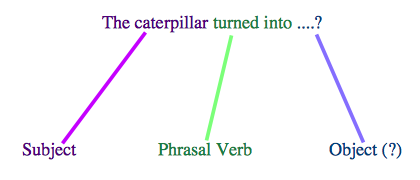
This is a phrasal verb that needs an object in order for the phrasal verb to make sense (transitive). the The two parts of the phrasal verb cannot be separated. That is, the object must come after all parts of the phrasal verb e.g.


Without an object we are left guessing what happens next, for example


This sentence has no meaning because the type of phrasal verb used must have an object.


Examples of Type 2 Phrasal Verbs

to be into = to be interested in, to like and to do as a hobby 
e.g. I'm into rock music. I go to gigs all the time.

to pick on = to bully and be mean to
e.g. The children in the playground picked on Mark because he was the smallest.

Type 3
Transitive separable phrasal verb

This is a phrasal verb that needs an object in order for the phrasal verb to make sense (transitive).  However, unlike Type 2 this phrasal verb can be separated. This means that the object can go between the verb part and the preposition or adverb part of the phrasal verb.
Below is an example of a phrasal verb in a sentence that is not separated.


Below is an example of the phrasal verb separated by the object.


Quite often when we use transitive separable phrasal verbs, we use a pronoun between the verb and the preposition of adverb (usually because the object is known from a previous reference).


Examples of Type 3 Phrasal Verbs

to work out = to fix a problem, resolve an issue or dispute
e.g. We are having a difficult time in our relationship, but we will work it out.
        Let's work out the cause of this issue for once and for all.

to make up = to create something (usually a story, gossip or scandal)
e.g. He made up the story about the car crash.
       Did you make that up, or is it true?

Type 4
Three part phrasal verbs

These are phrasal verbs that have three parts to their form. Because of the three parts, they cannot be separated and are usually always used with an object.


Example of Type 4 Phrasal Verbs

to fall out with = to have a disagreement with, to have a dispute with, to have an argument with
e.g., I fell out with my friend two weeks ago, and we haven't spoken since.

to give out to = to scold or discipline for doing something wring, naughty or bold
e.g. His father gave out to him for throwing stones at the neighbors car.


So how do I use phrasal verbs?


Phrasal verbs follow the same rules as all other verbs. Therefore, to use phrasal verbs in the past, you change the verb part of the phrasal verb into the past form e.g.

Past simple
Last week I got up later than usual because I was on holidays.

Past Progressive
I was getting up early but my timetable changed.

Present Simple
I get up early every morning.

Present perfect progressive
I have been getting up early lately.

Future aspects
She is going to get up early tomorrow to get an earlier train. (plan)
I will get up early to collect you for the station. (intention)

Questions
Whats time do you get up at? (present simple)
Do you enjoy getting up early? (gerund form)


Remember !
Phrasal verbs need to be conjugated just like all other verbs:
I wake up early every morning.
You wake up early every morning.
He / She / It wakes up early every morning.
We wake up early every morning.
You (plural) wake up early every morning.
They wake up early every morning.


How do  know the meaning of phrasal verbs?


Some phrasal verbs' meaning is very near to the meaning of the verb. These are easier to remember and to understand when you read or hear them e.g. to hang up your coat means to hang your coat on a hook or clothes hanger. However some other phrasal verbs' meaning is completely different and unrelated to the verb e.g. to come up with a great idea means to think of a great idea.


So how can I learn phrasal verbs?


Like I mentioned before, it is important to treat phrasal verbs like vocabulary. Note them into your vocabulary notebooks and write example sentences of how they work. 
Another great idea is to give yourself a number of phrasal verbs to learn each week. I usually pick an easy number, like 5, and focus on those new verbs all week. In that week, I try to use them as much as possible in my communication practice, and I refresh them in my mind at least once a day.

The last thing to remember about phrasal verbs - phrasal verbs can be learned by all levels of English language learners. If you are learning English for the first time, it is essential that you learn phrasal verbs from the start. Many people make the mistake and think that phrasal verbs are for higher level learners only - this is not true. Phrasal verbs are for all levels.


Hope you enjoyed our post on phrasal verbs. If you have any questions you would like to ask, just add to the comments below. 

Thanks for learning with Solas English!


Monday, 17 April 2017

The Vocabulary Notebook

In this week's blog post we are going to look at tips for keeping a vocabulary notebook. Vocabulary notebooks are a great tool to help you increase your vocabulary when learning a second language. 


English has lot of vocabulary ranging from formal to informal phrases. Learning vocabulary can be overwhelming for students, and they often ask teachers for advice on how they can improve their level and knowledge of vocabulary. Many teachers will agree that a vocabulary notebook is a great tool for students. However, many teachers will also agree that students often start a vocabulary notebook, but they do not continue it. The reason for this may be that students don't know how to keep a vocabulary notebook or what should go into a vocabulary notebook. Here are some ideas to help you.

Methods

This is probably the most important thing about keeping a vocabulary notebook. There are different ways of recording new words. Remember that your vocabulary notebook is for you and no one else, so find a method or methods that work best for you. Here are some methods students use in their vocabulary notebooks:

Translation - a lot of students like to write the new word into their notebook with the translation next to it. This is good for a quick reference, but can limit students' learning of how to use the word.


Dictionary definition - a dictionary definition can offer you a little more extra information about the word than just it's meaning. Dictionaries show you how to say the word with phonetic symbols. They also tell you what word class the word belongs in, e.g. noun, verb, adverb


Example sentence - A very good way to learn how to use the word is to write an example sentence. This works very well for phrasal verbs or word collocations (words that often go together).


Organisation


We all have different ways of organising things, and we are all learning English for different reasons. It's important that you have a system in place in your vocabulary notebook, so that you can easily find words when you need them. There are a number  of ways to organise your notebooks.

Alphabetically - Just like a dictionary, you can divide your notebook up alphabetically to record your new words. 

By word class - Some students like to record their words by word class. They like to keep their verbs in one section, adjectives in another, adverbs in a different section etc. In this way students know more about how to use the words in sentences.

By context - For many people this is the best way to record and save vocabulary. You put all the words and phrases into one section according to how you will use them. For example, maybe you are going on holidays, and you have learned new phrases and words for booking a hotel. You can note all these phrases and words in the one section so they are easy to find when you need them. Likewise, if you are learning vocabulary for academic writing, you can save linking words and expressions in one section, so it's easy to refer to them when you are practicing your writing skills. It's important that you give each section a title, and having an index at the start of the notebook our using colour paper bookmarks can help you find the different sections easily.

By book unit and page - For students who are studying English in school and are using a course book, recording your vocabulary by the unit and page can be a great way to remember where the word came from. You can always return to the unit or page to practice the listening or the reading where the word came from.


Revision


So we have our vocabulary notebook, and we have saved some words and phrases in it - so what now? Well, use it! Take out your notebook and read through your notes every few days. Go back over the words you have recorded until you know them, and you don't need to look at them in your notebook anymore. Keep adding to the notebook and keep reading back over your notes. Use your notebook in conversations and when you are writing. Use your notebook in class and at language exchange meetings. The more you use it, the more your knowledge of vocabulary will grow.


We hope you enjoyed our tips for keeping a vocabulary notebook. Please comment below and tell us if you have any other tips for keeping a vocabulary notebook. What do you do in your notebook? Do you think vocabulary notebooks are a good idea? We would love to hear from you ...

Wednesday, 12 April 2017

Sentences - Part 1, Simple Sentences


In today's blog we are going to look at some of the rules around sentence structures. In this post we will look at simple sentences and some of the problems we might have with sentence structures when we writing in English.


So first of all, what is a sentence?

A sentence is a group of words (independent clause) that:

  • Contains at least one subject and one verb.
  • Expresses a complete though.
There are four kinds of sentences in English:
  • Simple sentences
  • Compound sentences
  • Complex sentences
  • Compound-complex sentences

In this post we are going to look at Simple Sentences

A simple sentence has one subject/verb pair. The subject tells who or what did something. The verb tells the action (jump, work, think) or condition (is, was, seem, appear). Some simple sentences may have an object also. The object is the receiver of the verb by the subject. However, not all sentences have an object, e.g. I travel a lot.

In order for a sentence to be  grammatically correct, the sentence must have a subject/verb agreement. Look at these examples:


A simple sentence can have one of several possible 'formulas'. Here are four possibilities:


Notice that the subject in a simple sentence may have two or more items (sentences 2 and 4). The verb may have two or more items (sentences 3 and 4). 

Subject/Verb Agreement

You already know that the subject and verbs agree in number:


So here are some common errors with subject/verb agreement:

1. When a sentence begins with the word there + verb be, the subject follows the be verb. For example, 


2. A prepositional phrase (a group of words beginning with a preposition such as of, with, in, at or on, and ending with a noun or pronoun) can come between a subject and its verb. Prepositional phrases may come after a subject, but they are not part of the subject.


3. Some words are always singular:


4. A few words are always plural:


5. A few words can be either singular or plural. In these cases, you must refer to the noun in the prepositional phrase:


Fragmented Sentences

In some languages , you can sometimes leave out the subject in a sentence; in others, you can sometimes leave out the verb.

In English, you must ALWAYS have at least one subject and one verb in every sentence. If you leave either the subject or the verb, your sentence is incomplete. We call an incomplete sentence a fragment, or fragment sentence.

These are fragments. Fragments are sentence errors.


Reference: Oshima, A and Hogue A, Introduction to Academic Writing, 3rd Ed., Pearson Longman

So now we have reviewed Simple Sentences. Check out our next blog post in our sentences series - Part 1, Compound Sentences

Sentences - Part 2, Compound Sentences


In part 2 of our sentence series we talk about compound sentences. In this blog we will look at what compound sentences are, and what are the important features we need to consider when writing compound sentences.


What is a compound sentence?

A compound sentence is composed of at least two independent clauses joined by a comma and a co-ordinating conjunction. An independent clause, like a simple sentence, has a subject + verb and carries its own meaning (see the blog post Sentences - Part 1, Simple Sentences for more information).

A compound sentence has the following 'formula':


There are seven co-ordinating conjunctions in English. You can easily remember them by using the acronym FANBOYS. The English co-ordinating conjunctions are:

For has the same meaning as because; use for to introduce a reason or cause.
It is not easy to get there, for you have to hike down a long rail.

And joins sentences that are alike
He dropped the rice ball, and it rolled into a hole in the ground.

Nor means 'not this and not that'; use nor to join two negative clauses. You must use question word order after nor; place the auxiliary verb before the subject.
She didn't talk, nor did she move.
The book isn't very long, nor is it difficult to read.

But joins sentences that are opposite or show contract.
They were happy, but they were poor.

Or joins sentences that give choices or alternatives
He could choose a big box, or he could choose a small one.

Yet has approximately the same meaning as but; that is, it shows contrast or joins opposite. Use yet when the second part (clause) of the sentence says something is unexpected or surprising.
I was scared, yet I was also curious about the old lady.

So joins sentences when the second sentence expresses the result of something described in the first sentence.
The greedy man wanted all the mice's gold, so he pretended to be a cat.

* So (that) can also be used as a subordinator (see Sentences part 3 - Complex sentences) when connecting two clauses for a 'purpose'. In academic writing Therefore would be a more suitable linking word for this reason.


Using a comma with co-ordinating conjunctions

Use a comma before a co-ordinating conjunction in compound sentences only. Do not use a comma to join two words of two phrases in a simple sentence:


Run-ons and Comma Slices

Run-ons and comma slices are similar errors. Both happen when you join sentences incorrectly.

Run-ons happen when you join two simple sentences without a comma and without a connecting word. For example,

Men like to shop quickly women like to browse.


A comma slice error happens when you join two simple sentences with a comma alone. For example,

Men like to shop quickly, women like to browse.


There are three ways to correct run-on and comma slice errors:

* We will look at these in a different blog post


Proofreading techniques: How to find run-ons and comma slices in your writing.


Compound Sentences with Conjunctive Adverbs


A second way to form a compound sentence is as follows:


Independent clause; + conjunctive adverb+ independent clause


Salt water boils at a higher temperature than freshwater; therefore, food cooks faster in salt water.


When writing a compound sentence in this structure, it is important to use the correct punctuation. You should put a semicolon (;) before and a comma (,) after the conjunctive adverb.


Reference: Oshima, A and Hogue A, Introduction to Academic Writing, 3rd Ed., Pearson Longman

In this blog post we reviewed compound sentences. Check out our next blog post in our sentences series, Sentences - Part 3, Complex Sentences