Showing posts with label Learn English. Show all posts

Monday, 25 September 2017

The Future


In this blog post we are looking at how we relate to the future in the English language. 

It is very common for TEFL teachers to teach the grammar of the future aspects but not the meaning and use behind the grammar.

As a result, many English learners fall into the habit of using one of the aspects (usually 'will' of 'going to') more than the others. 

This blog looks at how English does not have a future tense, and how we use aspects of the language to create future meaning.


So what are these aspects?


So let's have a look at these meanings in a little more detail and learn how to use them!


Finally, a tip for teaching!


We hope you enjoyed this blog post. Please comment, share and like below.Solas English - teaching online in a fun way!


Tuesday, 30 May 2017

Phrasal Verbs

Phrasal verbs can be difficult for English language learners to learn. Many learners find them challenging; their meaning and their use. In this blog we will break down phrasal verbs and explain how you can become better at using and understanding these pieces of vocabulary.


First of all, it's very important to note that phrasal verbs are vocabulary. Just like walk is a word that describes an action (verb), take on is a collocation that describes an action (verb). Therefore, it is important to record phrasal verbs in the same way your record all your other vocabulary. For more tips on recording vocabulary, look at our post about vocabulary notebooks.

Another important thing to remember when working with phrasal verbs is; you should always use an English - English dictionary to check the meaning of the phrasal verbs. Trying to understand phrasal verbs on online translators or electronic translators can be a problem because the translator may translate the verb and the preposition or adverb separately rather than as one unit. I recommend the advanced learner dictionaries for English language learners.


First, what is a phrasal verb?


A phrasal verb is a multi-part verb. It is made up of a verb and a preposition or an adverb.


Why use phrasal verbs?


Phrasal verbs are often used in informal speech. However, this is not always the case as you can also use phrasal verbs in more formal situations, for example in business English or presentation English. Quite often, a lot of the verbs we use everyday are phrasal verbs. It is much more 'normal' for a native English language speaker to say

"Take off your coat and hang it up over there." 

instead of 

"Remove your coat and suspend it on the hook over there."


So how can I recognise or know phrasal verbs?


There are four types of phrasal verbs:

Type 1
Intransitive phrasal Verb

This means that the phrasal verb does not need a direct object to be used, for example


Examples of Type 1 Phrasal verbs

to work out = to do exercise 
e.g. I work out at the gym twice a week.

to freak out - to get very stressed, angry and annoyed with a person, thing or situation.
e.g. The students were freaking out because the university exams were starting that week.


Type 2
Transitive inseparable phrasal verb

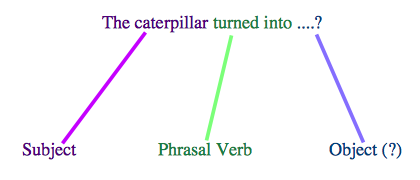
This is a phrasal verb that needs an object in order for the phrasal verb to make sense (transitive). the The two parts of the phrasal verb cannot be separated. That is, the object must come after all parts of the phrasal verb e.g.


Without an object we are left guessing what happens next, for example


This sentence has no meaning because the type of phrasal verb used must have an object.


Examples of Type 2 Phrasal Verbs

to be into = to be interested in, to like and to do as a hobby 
e.g. I'm into rock music. I go to gigs all the time.

to pick on = to bully and be mean to
e.g. The children in the playground picked on Mark because he was the smallest.

Type 3
Transitive separable phrasal verb

This is a phrasal verb that needs an object in order for the phrasal verb to make sense (transitive).  However, unlike Type 2 this phrasal verb can be separated. This means that the object can go between the verb part and the preposition or adverb part of the phrasal verb.
Below is an example of a phrasal verb in a sentence that is not separated.


Below is an example of the phrasal verb separated by the object.


Quite often when we use transitive separable phrasal verbs, we use a pronoun between the verb and the preposition of adverb (usually because the object is known from a previous reference).


Examples of Type 3 Phrasal Verbs

to work out = to fix a problem, resolve an issue or dispute
e.g. We are having a difficult time in our relationship, but we will work it out.
        Let's work out the cause of this issue for once and for all.

to make up = to create something (usually a story, gossip or scandal)
e.g. He made up the story about the car crash.
       Did you make that up, or is it true?

Type 4
Three part phrasal verbs

These are phrasal verbs that have three parts to their form. Because of the three parts, they cannot be separated and are usually always used with an object.


Example of Type 4 Phrasal Verbs

to fall out with = to have a disagreement with, to have a dispute with, to have an argument with
e.g., I fell out with my friend two weeks ago, and we haven't spoken since.

to give out to = to scold or discipline for doing something wring, naughty or bold
e.g. His father gave out to him for throwing stones at the neighbors car.


So how do I use phrasal verbs?


Phrasal verbs follow the same rules as all other verbs. Therefore, to use phrasal verbs in the past, you change the verb part of the phrasal verb into the past form e.g.

Past simple
Last week I got up later than usual because I was on holidays.

Past Progressive
I was getting up early but my timetable changed.

Present Simple
I get up early every morning.

Present perfect progressive
I have been getting up early lately.

Future aspects
She is going to get up early tomorrow to get an earlier train. (plan)
I will get up early to collect you for the station. (intention)

Questions
Whats time do you get up at? (present simple)
Do you enjoy getting up early? (gerund form)


Remember !
Phrasal verbs need to be conjugated just like all other verbs:
I wake up early every morning.
You wake up early every morning.
He / She / It wakes up early every morning.
We wake up early every morning.
You (plural) wake up early every morning.
They wake up early every morning.


How do  know the meaning of phrasal verbs?


Some phrasal verbs' meaning is very near to the meaning of the verb. These are easier to remember and to understand when you read or hear them e.g. to hang up your coat means to hang your coat on a hook or clothes hanger. However some other phrasal verbs' meaning is completely different and unrelated to the verb e.g. to come up with a great idea means to think of a great idea.


So how can I learn phrasal verbs?


Like I mentioned before, it is important to treat phrasal verbs like vocabulary. Note them into your vocabulary notebooks and write example sentences of how they work. 
Another great idea is to give yourself a number of phrasal verbs to learn each week. I usually pick an easy number, like 5, and focus on those new verbs all week. In that week, I try to use them as much as possible in my communication practice, and I refresh them in my mind at least once a day.

The last thing to remember about phrasal verbs - phrasal verbs can be learned by all levels of English language learners. If you are learning English for the first time, it is essential that you learn phrasal verbs from the start. Many people make the mistake and think that phrasal verbs are for higher level learners only - this is not true. Phrasal verbs are for all levels.


Hope you enjoyed our post on phrasal verbs. If you have any questions you would like to ask, just add to the comments below. 

Thanks for learning with Solas English!


Monday, 17 April 2017

The Vocabulary Notebook

In this week's blog post we are going to look at tips for keeping a vocabulary notebook. Vocabulary notebooks are a great tool to help you increase your vocabulary when learning a second language. 


English has lot of vocabulary ranging from formal to informal phrases. Learning vocabulary can be overwhelming for students, and they often ask teachers for advice on how they can improve their level and knowledge of vocabulary. Many teachers will agree that a vocabulary notebook is a great tool for students. However, many teachers will also agree that students often start a vocabulary notebook, but they do not continue it. The reason for this may be that students don't know how to keep a vocabulary notebook or what should go into a vocabulary notebook. Here are some ideas to help you.

Methods

This is probably the most important thing about keeping a vocabulary notebook. There are different ways of recording new words. Remember that your vocabulary notebook is for you and no one else, so find a method or methods that work best for you. Here are some methods students use in their vocabulary notebooks:

Translation - a lot of students like to write the new word into their notebook with the translation next to it. This is good for a quick reference, but can limit students' learning of how to use the word.


Dictionary definition - a dictionary definition can offer you a little more extra information about the word than just it's meaning. Dictionaries show you how to say the word with phonetic symbols. They also tell you what word class the word belongs in, e.g. noun, verb, adverb


Example sentence - A very good way to learn how to use the word is to write an example sentence. This works very well for phrasal verbs or word collocations (words that often go together).


Organisation


We all have different ways of organising things, and we are all learning English for different reasons. It's important that you have a system in place in your vocabulary notebook, so that you can easily find words when you need them. There are a number  of ways to organise your notebooks.

Alphabetically - Just like a dictionary, you can divide your notebook up alphabetically to record your new words. 

By word class - Some students like to record their words by word class. They like to keep their verbs in one section, adjectives in another, adverbs in a different section etc. In this way students know more about how to use the words in sentences.

By context - For many people this is the best way to record and save vocabulary. You put all the words and phrases into one section according to how you will use them. For example, maybe you are going on holidays, and you have learned new phrases and words for booking a hotel. You can note all these phrases and words in the one section so they are easy to find when you need them. Likewise, if you are learning vocabulary for academic writing, you can save linking words and expressions in one section, so it's easy to refer to them when you are practicing your writing skills. It's important that you give each section a title, and having an index at the start of the notebook our using colour paper bookmarks can help you find the different sections easily.

By book unit and page - For students who are studying English in school and are using a course book, recording your vocabulary by the unit and page can be a great way to remember where the word came from. You can always return to the unit or page to practice the listening or the reading where the word came from.


Revision


So we have our vocabulary notebook, and we have saved some words and phrases in it - so what now? Well, use it! Take out your notebook and read through your notes every few days. Go back over the words you have recorded until you know them, and you don't need to look at them in your notebook anymore. Keep adding to the notebook and keep reading back over your notes. Use your notebook in conversations and when you are writing. Use your notebook in class and at language exchange meetings. The more you use it, the more your knowledge of vocabulary will grow.


We hope you enjoyed our tips for keeping a vocabulary notebook. Please comment below and tell us if you have any other tips for keeping a vocabulary notebook. What do you do in your notebook? Do you think vocabulary notebooks are a good idea? We would love to hear from you ...

Monday, 10 April 2017

IELTS Speaking Test Tips


In this week's blog we are looking at the IELTS Speaking test, and we have listed some tips below to help you improve your performance. It's a good idea to look up some practice test tips while you are preparing for the test and to watch some example videos on Youtube. Before the test, practise speaking as often as you can and make sure that you can talk for two minutes on a topic. For a good score it's important to answer each question fully but, do not try to learn answers for the test. Studying all aspects of English including pronunciation, vocabulary and grammar will help improve your IELTS score. Here are some other tips to help you prepare:


What is the layout of the IELTS speaking test?

The interview has three separate parts and is divided up as follows:

Part 1 (4-5 minutes)
The examiner will ask you questions about familiar topic (e.g. hobbies, likes and dislikes, daily routine).

Part 2 (3-4 minutes)
The examiner will give you a handout showing a topic and some suggestions on it. You need to talk about the topic for 1-2 minutes. You have one minute to write notes and prepare before you begin. The examiner may ask you some follow-up questions.

Part 3 (4-5 minutes)
The examiner will ask you more detailed and more abstract questions linked to the topic in part 2.

How is the speaking test assessed?


The examiner will listen carefully to your answers and will assess your speaking according to the following criteria:

Fluency and coherence - Do you speak fluently and are you easy to understand? Do you link your ideas together?

Lexical resource - Can you use a wide range of vocabulary accurately and the effectively? Can you explain your ideas even if you do not know particular words? Can you use or attempt to use higher-level vocabulary correctly?

Grammatical range and accuracy - Can you use a wide range of grammatical structures rather than repeating basic structures? Do you often make grammatical mistakes?

Pronunciation - Is your spoken language clear and easily understood? Do you use stress and intonation to add extra meaning? Do you use stress word stress accurately?


Now for some tips!


Speaking Test Part 1 


Arrive early to the test so you are not in a hurry and stressed. Give yourself time to relax at the test centre. It's a good idea to visit the test centre a few days before the test, so you know where to go on the day of the test.

Eye contact with the examiner is important, so make good eye contact from the minute you enter the room. Speak and answer questions in a polite and friendly way. Body language is an important part of communicating so be aware of hand gestures or how you are sitting.

The speaking test should be more like a natural conversation between two people. If you learn chunks of language or give a prepared speech, the examiner will know and interrupt you to ask you a different question.

Good communication skills also includes good listening skills. Listen to the examiner's questions so that you can answer correctly. For example, listen for what tenses the questions are in and answer in the correct tense. If you are asked a yes/no question, be sure to answer with yes or no and then give your reason by using linking words like 'because'. Don't just say yes or no only.


Speaking Test Part 2 


Your notes are a reference only, so only look at notes briefly. Don’t read directly from your notes and keep eye contact with the examiner.

If you run out of ideas after one minute, look at your notes, or look at the task in the booklet again. 

When you are making your notes, write notes. Do not write full sentences. It is a good opportunity to put down as much vocabulary you can think of for the topic. It is a good idea to link your vocabulary to your ideas. Make sure you can read your notes easily, so when you quickly look down they are easy to see. Practice note-making before the exam so you can create a system that helps you read notes when you look down very fast. 


Speaking Test Part 3 


Listen carefully to the examiner’s questions so you know how to answer them. If you don't understand a question, don't be shy about asking the examiner to repeat the question again.

In each part of the test, it is very important to answer all of the questions as fully as possible. Full answers will help improve your score,  so expand on your answers as much as you can. 

It is important to have your own opinion. Try to read newspapers and watch the news to keep up with current issues. Your opinion is valid, but it's important that you can explain or support you opinion.

Don’t be afraid to disagree with the opinions of the examiner. The examiner is assessing your language - not your opinions. The test is simply an opportunity for you to show your language skills, and your ability to express your ideas. 


Reference: 2014, Cullen, French and Jakeman. The Official Cambridge Guide for IELTS for Academic and General Training, Cambridge University Press and UCLES


If you want to practice and prepare for an IELTS exam, we offer one-to-one Skype classes. Contact us for more information or visit our website www.solasenglish.com

Wednesday, 5 April 2017

The cats in Japan


 For the next few months I will be in Japan teaching an IELTS course. This is my third visit to Japan, and so to celebrate the beginning of another semester here this blog post is about how I used art in the English language classroom in Japan last year for a lesson of rhyming, culture and autonomous learning.


Many teachers think that having students do artistic projects in the language classroom can be a waste of time. However, I believe that the context, the approach and the task are very important factors to consider when planning to use art in the language classroom. Here's an example of how I used art to encourage autonomous learning, aspects of pronunciation and intercultural awareness.


Last year I was working with a group of students who were training to be elementary school teachers. Part of their curriculum was not only to learn English but how they could teach English to very young learners. The curriculum looked at teaching methods such as games and activities. It also looked at how books can be used with young learners.


For this particular task we were working with the book "My Cat Likes to Hide in Boxes" by Lynley Dodd. This book has a lot of rhyming in it. This was a little difficult for the group of low level learners I had, so to help them with the concept of rhyming I set them the task to make a poster based on "The cat from Ireland ...."


The students had to find information about Ireland and Irish culture - promoting autonomous learning and cultural awareness. They then had to make an attempt to complete the poster title - allowing students to play around with rhyming.


The result was great: the students were encouraged to work autonomously on the project with the teacher available to support them. It was a great introduction to my country and culture, Ireland, because they knew very little about it. Therefore it turned into a great cultural awareness project also. Finally, the students got to play around with rhyming. It took them some time but they had a better understanding of how sounds can be similar and how words in English rhyme. It was also challenging for them because they realised that words with similar spellings don't always sound the same.

 .... of course we had a lovely colourful wall of cat posters to brighten our day!


So, how can art help you develop your English language skills?


All cultural things gives us a great insight into how a culture works. The more we understand about a culture and how it works, the more we can understand how and why people talk in that culture the way they do. Art can be a visual window into understanding culture and therefore, understanding communication in that culture. Remember art is not always paintings and sculptor. Modern art incorporates so much more media now like film and contemporary performance, and can be found not only in galleries but online and in magazines.


"The more we understand about a culture and how it works, the more we can understand how and why people talk in that culture the way they do."


Comment below and tell us: Which is your favourite poster? Does your English language teacher use art in the English language classroom? Have you ever done a project like this, and what was it like? Who is your favourite artist and why?