

Phrasal verbs can be difficult for English language learners to learn. Many learners find them challenging; their meaning and their use. In this blog we will break down phrasal verbs and explain how you can become better at using and understanding these pieces of vocabulary.
First of all, it's very important to note that phrasal verbs are vocabulary. Just like walk is a word that describes an action (verb), take on is a collocation that describes an action (verb). Therefore, it is important to record phrasal verbs in the same way your record all your other vocabulary. For more tips on recording vocabulary, look at our post about vocabulary notebooks.
Another important thing to remember when working with phrasal verbs is; you should always use an English - English dictionary to check the meaning of the phrasal verbs. Trying to understand phrasal verbs on online translators or electronic translators can be a problem because the translator may translate the verb and the preposition or adverb separately rather than as one unit. I recommend the advanced learner dictionaries for English language learners.


First, what is a phrasal verb?
A phrasal verb is a multi-part verb. It is made up of a verb and a preposition or an adverb.
Why use phrasal verbs?
Phrasal verbs are often used in informal speech. However, this is not always the case as you can also use phrasal verbs in more formal situations, for example in business English or presentation English. Quite often, a lot of the verbs we use everyday are phrasal verbs. It is much more 'normal' for a native English language speaker to say
"Take off your coat and hang it up over there."
instead of
"Remove your coat and suspend it on the hook over there."
So how can I recognise or know phrasal verbs?
There are four types of phrasal verbs:
Type 1
Intransitive phrasal Verb
This means that the phrasal verb does not need a direct object to be used, for example

Examples of Type 1 Phrasal verbs
to work out = to do exercise
e.g. I work out at the gym twice a week.
to freak out - to get very stressed, angry and annoyed with a person, thing or situation.
e.g. The students were freaking out because the university exams were starting that week.
to freak out - to get very stressed, angry and annoyed with a person, thing or situation.
e.g. The students were freaking out because the university exams were starting that week.
Type 2
Transitive inseparable phrasal verb
This is a phrasal verb that needs an object in order for the phrasal verb to make sense (transitive). the The two parts of the phrasal verb cannot be separated. That is, the object must come after all parts of the phrasal verb e.g.

Without an object we are left guessing what happens next, for example
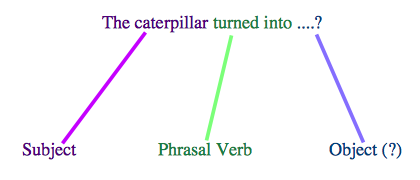
This sentence has no meaning because the type of phrasal verb used must have an object.
Examples of Type 2 Phrasal Verbs
to be into = to be interested in, to like and to do as a hobby
e.g. I'm into rock music. I go to gigs all the time.
to pick on = to bully and be mean to
e.g. The children in the playground picked on Mark because he was the smallest.
to pick on = to bully and be mean to
e.g. The children in the playground picked on Mark because he was the smallest.
Type 3
Transitive separable phrasal verb
This is a phrasal verb that needs an object in order for the phrasal verb to make sense (transitive). However, unlike Type 2 this phrasal verb can be separated. This means that the object can go between the verb part and the preposition or adverb part of the phrasal verb.
Below is an example of a phrasal verb in a sentence that is not separated.
Below is an example of a phrasal verb in a sentence that is not separated.

Below is an example of the phrasal verb separated by the object.

Quite often when we use transitive separable phrasal verbs, we use a pronoun between the verb and the preposition of adverb (usually because the object is known from a previous reference).


Examples of Type 3 Phrasal Verbs
to work out = to fix a problem, resolve an issue or dispute
e.g. We are having a difficult time in our relationship, but we will work it out.
Let's work out the cause of this issue for once and for all.
to make up = to create something (usually a story, gossip or scandal)
e.g. He made up the story about the car crash.
Did you make that up, or is it true?
to make up = to create something (usually a story, gossip or scandal)
e.g. He made up the story about the car crash.
Did you make that up, or is it true?
Type 4
Three part phrasal verbs
These are phrasal verbs that have three parts to their form. Because of the three parts, they cannot be separated and are usually always used with an object.


Example of Type 4 Phrasal Verbs
to fall out with = to have a disagreement with, to have a dispute with, to have an argument with
e.g., I fell out with my friend two weeks ago, and we haven't spoken since.
to give out to = to scold or discipline for doing something wring, naughty or bold
e.g. His father gave out to him for throwing stones at the neighbors car.
to give out to = to scold or discipline for doing something wring, naughty or bold
e.g. His father gave out to him for throwing stones at the neighbors car.
So how do I use phrasal verbs?
Phrasal verbs follow the same rules as all other verbs. Therefore, to use phrasal verbs in the past, you change the verb part of the phrasal verb into the past form e.g.
Past simple
Last week I got up later than usual because I was on holidays.
Past Progressive
I was getting up early but my timetable changed.
Past Progressive
I was getting up early but my timetable changed.
Present Simple
I get up early every morning.
Present perfect progressive
I have been getting up early lately.
Future aspects
She is going to get up early tomorrow to get an earlier train. (plan)
I will get up early to collect you for the station. (intention)
Questions
Whats time do you get up at? (present simple)
Do you enjoy getting up early? (gerund form)
Remember !
Phrasal verbs need to be conjugated just like all other verbs:
I wake up early every morning.
You wake up early every morning.
He / She / It wakes up early every morning.
We wake up early every morning.
You (plural) wake up early every morning.
They wake up early every morning.
Remember !
Phrasal verbs need to be conjugated just like all other verbs:
I wake up early every morning.
You wake up early every morning.
He / She / It wakes up early every morning.
We wake up early every morning.
You (plural) wake up early every morning.
They wake up early every morning.
How do know the meaning of phrasal verbs?
Some phrasal verbs' meaning is very near to the meaning of the verb. These are easier to remember and to understand when you read or hear them e.g. to hang up your coat means to hang your coat on a hook or clothes hanger. However some other phrasal verbs' meaning is completely different and unrelated to the verb e.g. to come up with a great idea means to think of a great idea.
So how can I learn phrasal verbs?
So how can I learn phrasal verbs?
Like I mentioned before, it is important to treat phrasal verbs like vocabulary. Note them into your vocabulary notebooks and write example sentences of how they work.
Another great idea is to give yourself a number of phrasal verbs to learn each week. I usually pick an easy number, like 5, and focus on those new verbs all week. In that week, I try to use them as much as possible in my communication practice, and I refresh them in my mind at least once a day.
The last thing to remember about phrasal verbs - phrasal verbs can be learned by all levels of English language learners. If you are learning English for the first time, it is essential that you learn phrasal verbs from the start. Many people make the mistake and think that phrasal verbs are for higher level learners only - this is not true. Phrasal verbs are for all levels.


